

** This is a sponsored post. I received this product or compensation for review purposes only and was compensated for my time. I was not asked nor required to share a positive review; all opinions are my own. READ DISCLAIMER HERE for more information.
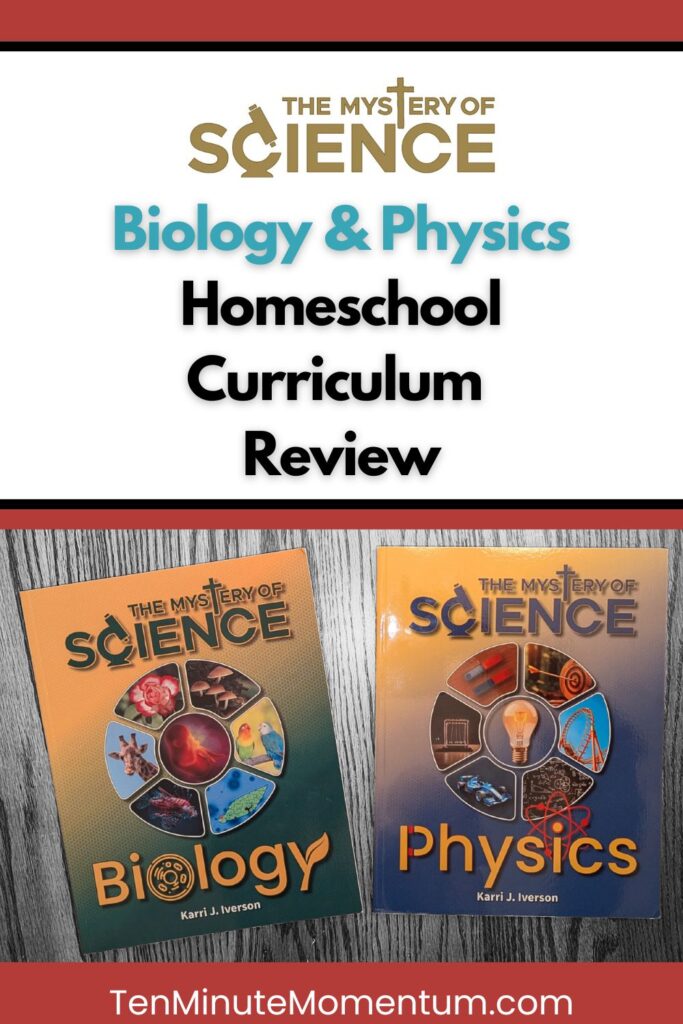
Finding homeschool science can be a real challenge so I was excited to take a look at The Mystery of Science Biology and Physics for 4th to 8th grade students.
When I began homeschooling my kids 18 years ago, one subject quickly rose to the top of my “this is hard” list: science.
I’ve always enjoyed the practical side of science—gardening, eating nutritious foods, natural remedies, and observing nature. But when it came to structured science lessons, textbooks, and labs, it often felt overwhelming.
My goal as a homeschool parent has always been simple: raise kids who are prepared for whatever comes next.…college, trade school, working, or starting a business.
Very early on, I realized something important about my older kids—they loved science. It became clear that at least a few of them might eventually pursue science-related careers.
That meant we needed to cover science in a way that built real knowledge, prepared them for high school science, and didn’t overwhelm me as the parent-teacher. At home we did plenty of experiments, bought science kits, and built models. But when it came to structured textbook learning, we often outsourced science to co-ops, microschools, or private classes.
Why?
Because teaching science at home often felt like a lot. Textbooks were too academic, chapters were too long, labs weren’t included, or teachers had to piece together experiments from multiple sources.
The Science Curriculum We Were Always Searching For
When I became the director of a homeschool co-op, we started ordering elementary and middle school science curriculum just to look at it.
We were searching for something very specific. Nothing complicated…
After running a co-op for several years, we knew we wanted science curriculum that had four things:
- Colorful, short, engaging lessons that did not overwhelm students
- Meaningful assignments in a workbook
- Experiments included in the lessons
- Designed to cover a full school year
That was it.
Because it was a Christian co-op, we also preferred curriculum that was neutral or Christian, but there are quite a few options that fit that category.
Here was the challenge…most curriculum met just three out of four goals. Something was always missing….which meant teachers always had to rework something.
Because we searched so intentionally for science curriculum years ago, I still evaluate science curriculum through that same lens today.
Is this good for the students? Is it good for the parent or teacher?
Would this work for a group with mixed ages and grades?
Discovering The Mystery of Science
When I had the chance to use and review The Mystery of Science Biology and Physics, I knew almost immediately that I might be holding the curriculum we had been looking for all those years.
I remember flipping through the textbook and workbook and thinking:
“This might actually be it.”
In fact, I started telling people in our co-op almost immediately: “Guys, you have to check this one out. I think this is it…the science curriculum we have been looking for.”
So let me share a few things I really like about this curriculum.
Table of Contents
The Mystery of Science Biology
So if you use The Mystery of Science Biology, I think the biggest thing that I can say is that you will feel like this is totally manageable. I don’t know about you, but language arts and math get a lot of my bandwidth as a parent when my kids are elementary school. I’d like to say its different in middle school…but unmotivated middle schoolers are a whole other can of worms!
Each lesson of Biology feels like you are using a high school textbook scaled way down to your 4th-8th grade level.
And the student lab book is designed to help students pull information out of the textbook in a systematic way that will help them retain information. The layout of the text and the lab book make it easy for students to find the information they are being asked to write in the notebook.
As a mom who has used SO MANY different science textbooks, I really appreciate how intuitive this textbook and notebook feel.
The experiments are diverse and fun and cover a wide variety of topics. There is an easy supply checklist at the beginning of the notebook which makes gathering up lab supplies fairly simple. I would say about 85% of the supplies are household items and a few things you might need to order online.
The Mystery of Science Physics
A couple of my sons took high school Physics and it was such a challenge. So when I opened this textbook, I was expecting to feel overwhelmed. But it was nothing like I expected!
The textbook does a great job of covering key Physics concepts, but without requiring the math to DO the physics equations. Instead, students learn about key figures in history who make scientific discoveries. It also includes core concepts key to understanding how physics works…and then moves on to force, states of matter, motion, energy, heat and sound and more.
Students who use this text will become comfortable observing all the ways physics is used all around us…without feeling overwhelmed by math…that might prevent them from enjoying what they are learning about.
One of my sons is a Chemical Engineering major and we did all the rigorous math. But I always wished that my less mathy kids would have been able to explore and enjoy some of the “hard” subjects without feeling so overwhelmed. This textbook is a really perfect introduction into this subject…without the overwhelm!
What I Love About The Mystery of Science!
1. Short, Colorful Lessons
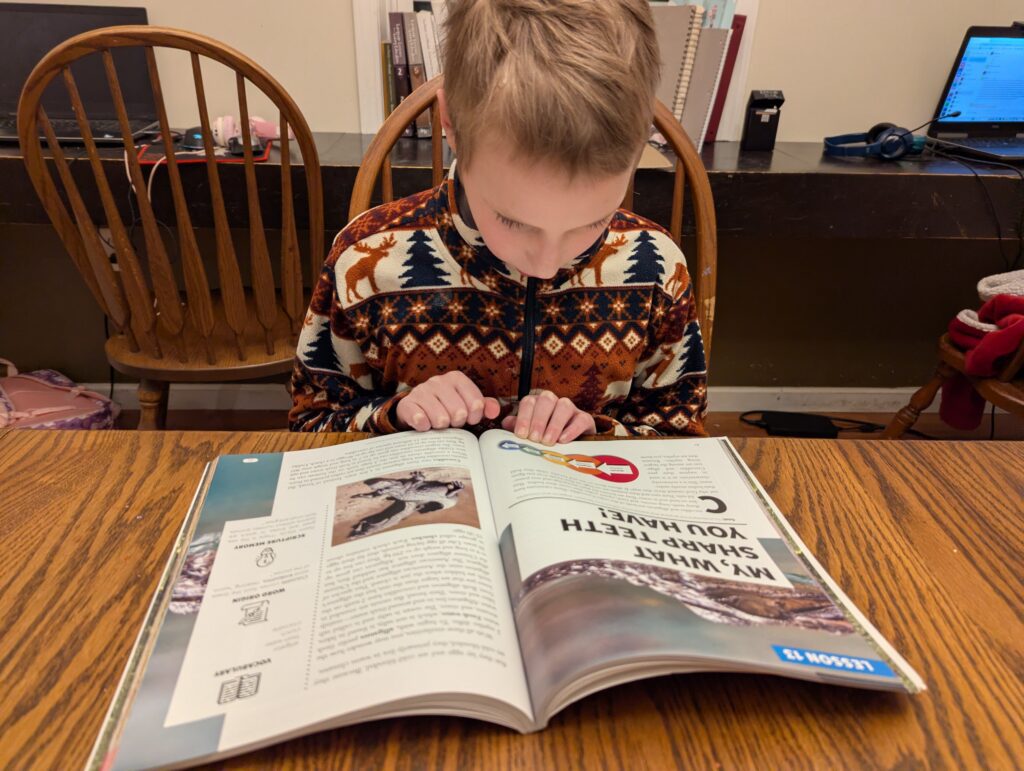
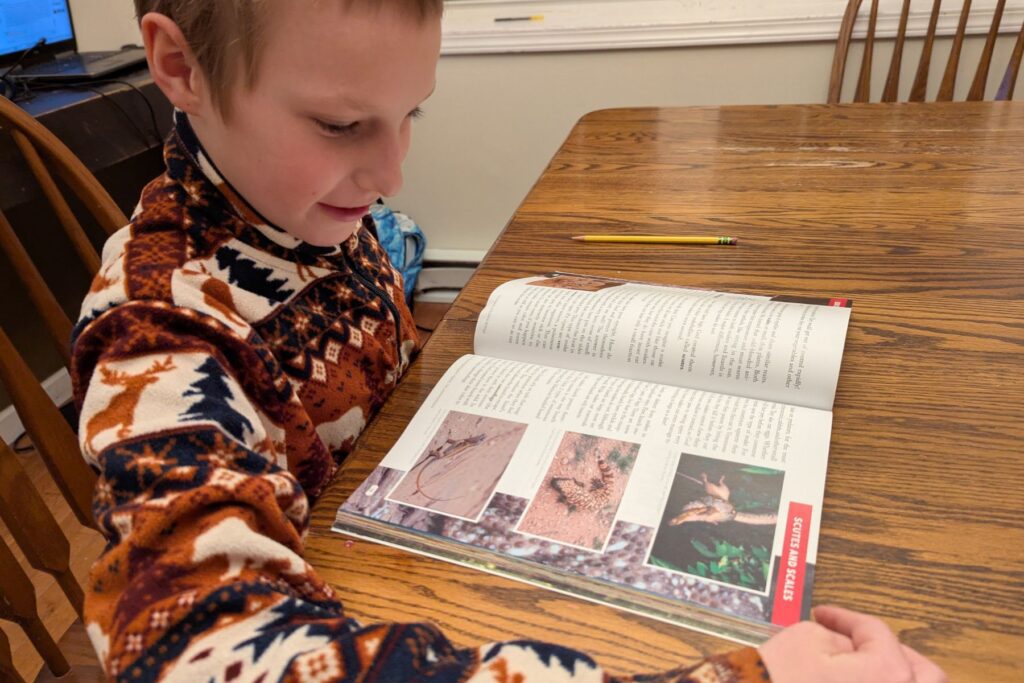
The student reader is full color, with lots of visual interest on every page. Before we ever started reading the textbook, I had it out on the table. My 11 year old son said…”I’ve been eyeing that book…I want to read it!” I wasn’t surprised…the book is visually very appealing. The lessons are short—usually just a couple of pages—which makes them very manageable for students in 4th through 8th grade. The reading level is approachable for that age group, and the layout keeps students engaged.
You could also easily use this curriculum with younger kids, although an adult might want to read the lesson aloud.
2. Vocabulary That Builds a Strong Foundation
Each lesson includes key vocabulary words that function as building blocks for future science learning. If your student completes the Biology course, the vocabulary they learn provides a great foundation for leveling up when they take biology in high school.
Instead of encountering these words for the first time later, students already have familiarity with the concepts.
3. Courses That Mirror High School Science Topics
One thing I’ve noticed in homeschool science is that we sometimes focus on very narrow topics and end up missing some foundational ideas.
For example, we might spend weeks studying frogs, birds, or insects. While that can be interesting, students can end up with gaps in their overall science knowledge. I’m a fan of deep dives into student interests, but sometimes a more comprehensive approach is also really helpful.
The Mystery of Science takes a broader approach. The subjects that have been released—and those currently planned—mirror the types of science courses students will encounter in high school. This helps students build a strong foundation of scientific knowledge and prevents those frustrating gaps later on.
Right now, the courses that are available are Biology and Physics, but Chemistry is coming in 2026 and will be followed by Earth Science, Astronomy, Health and Nutrition, Marine Science, Forensics, and Botany.
Each of these subjects creates a foundational based of vocabulary that prepares students well for high school level courses in related areas!
4. Flexible Workbook Options
A digital workbook is included with the curriculum. This is helpful for families who don’t want to deal with a large number of worksheets. You can simply print the pages you want to use.
There is also a physical workbook available for families who prefer a traditional format. The workbook includes activities such as vocabulary work, scripture memory, writing assignments, research activities, and experiments. For co-op classes, having a physical workbook can make things much easier since teachers don’t have to make copies for students.
5. Experiments Included in Every Lesson
One of the best features of this curriculum is that the experiments and hands-on activities are built directly into the workbook. You don’t have to hunt for labs or piece together activities from multiple sources.
Each lesson is designed to cover one week of science, and the experiments are clearly outlined in the workbook. For busy homeschool parents or co-op teachers, this makes lesson preparation much simpler.
6. Flexible for Different Ages and Learning Levels
Another thing I appreciate about The Mystery of Science is how flexible it is. Each lesson follows a consistent structure that includes Bible memory, vocabulary, writing, research, and experiments.
Parents and teachers can easily adjust how much work students complete based on age, learning ability, and available time. This makes the curriculum especially useful for families teaching multiple ages or co-op classes with mixed grade levels.
What’s Included in the Curriculum
The Mystery of Science courses are refreshingly simple when it comes to materials.
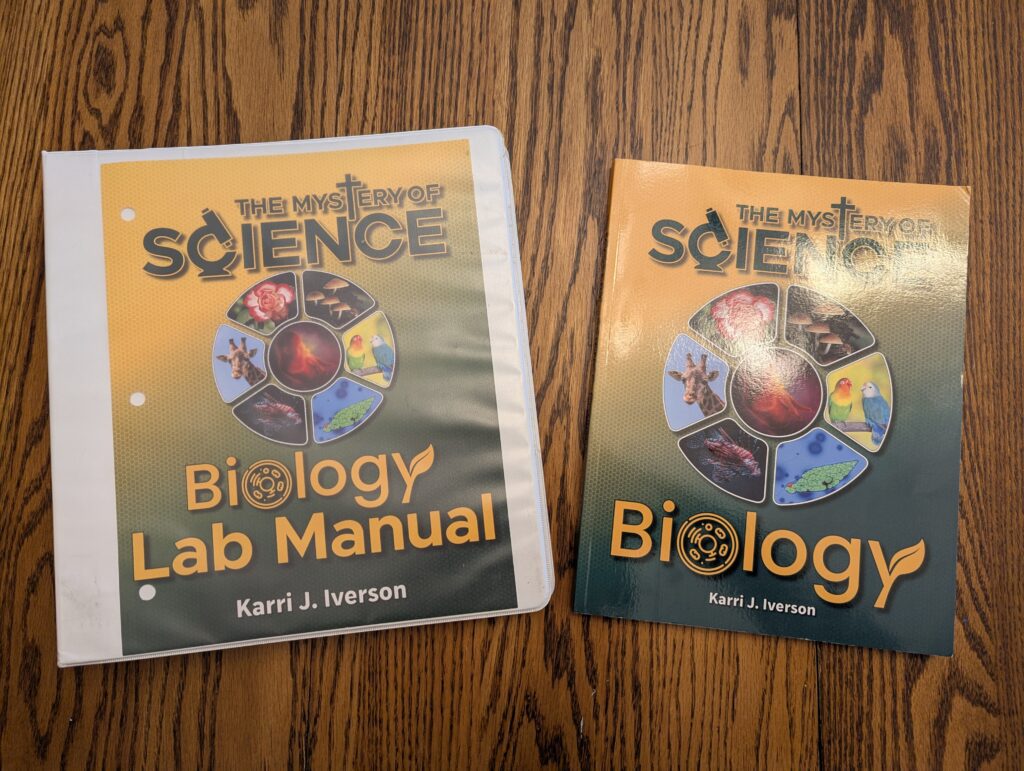
The core curriculum includes two main components.
- Student Textbook – This contains the science lessons and explanations.
- Student Lab Manual -The lab manual contains the activities that accompany each lesson.
Students complete vocabulary practice, writing assignments, research activities, diagrams and sketches, experiments, quizzes, and tests. Families can choose either a digital lab manual or a printed workbook.
What a Typical Week Looks Like
The curriculum is designed to be used over 4–5 days per week. A typical week might look like this.
- Day 1 -Read the lesson in the textbook.
- Days 2–4 -Complete 1–2 pages of activities per day in the lab manual.
- Final Day -Take the weekly quiz. The answer key is included in the back of the lab manual.
If you are a parent of a younger student, you could simply even further by simply reading the lesson once a week.
An Unexpected Bonus: Science Writing
One thing I noticed while looking through the workbook was how many science-based writing opportunities were included. Students regularly explain scientific ideas, summarize what they learned, and record observations.
For some students—especially those drawn to science—writing about scientific ideas can feel more meaningful than traditional language arts assignments. I saw this with one of my sons who is now studying Chemical Engineering.
He never loved writing assignments growing up. But once he started taking science classes that required explanations and lab reports, writing suddenly made more sense to him. Even in college, he had to take technical writing instead of a traditional English Composition class.
Because of that experience, I think some families could even use this curriculum as a writing spine for the year, especially for students who lean strongly toward STEM. You could focus language arts primarily on literature, reading, and grammar while completing the writing assignments included in the science workbook.
How The Mystery of Science Works in a Homeschool Co-op
As a former homeschool co-op director, I’m always evaluating curriculum through the lens of “Would this work well in a group class?” The Mystery of Science fits a co-op model very well.
It would be so easy to have the students read the text at home and do most of the lab manual at home too. Then on a co-op day, have the students do the labs or activities in class and take a quiz in class too. Of course there are other variations, but the consistent layout in every chapter would make planning and implementing this in a group quite easy.
Because the lessons are short and clearly organized, students can come to class prepared to participate, which makes the group time much more productive.
If copies of the lab manual are going to be made for students, then each student should have their own copy of the student textbook so they can follow along with the lesson material.
Don’t Miss A Curriculum That Checks The Boxes!
After reviewing many elementary and middle school science programs over the years, I can honestly say that The Mystery of Science checks the boxes we were always looking for.
It combines short, engaging lessons, meaningful workbook activities, hands-on experiments, and a full year of structured science in a way that works well for both students and the adults teaching them. For homeschool families and co-ops looking for a science curriculum that is both practical and engaging, The Mystery of Science is definitely worth taking a closer look.

Sarah McCubbin and her husband and 9 kids live in Ohio. She loves talking about all kinds of education topics and is passionate about helping families find the best education options in each season! After being very socially awkward growing up, she now loves to help families teach life skills, social skills and leadership to their kids!
Connect With Sarah:
Schooling Year By Year Facebook Group
Facebook Page / Instagram @ten_minute_momentum
PallasCenter.com / IndieEducationNetwork.com