
If you’re looking for a hands-on, story-driven homeschool science curriculum that makes history come alive while also teaching solid science concepts, Science in the Industrial Age by Berean Builders is a standout choice.
As a homeschool mom of nine kids, I’ve used just about every type of Christian homeschool science program out there — from dry textbooks to flashy experiment kits.
What I love about Berean Builders’ Science in the Industrial Age is how it weaves science into the historical context of the 19th century while keeping lessons engaging for kids from early elementary through middle school. We started using Berean Builder’s elementary curriculum many years ago when our homeschool co-op decided to follow a 4-year history cycle. We decided that for the younger years we wanted something that would line up with those time periods and Berean Builders elementary science was a perfect companion.
** This is a sponsored post. I received this product or compensation for review purposes only and was compensated for my time. I was not asked nor required to share a positive review; all opinions are my own. READ DISCLAIMER HERE for more information.
This is not “just” a science textbook — it’s a tour through history that shows students how discoveries happened, who made them, and how they connect to what we know today. And the best part? Nearly every lesson includes an activity or experiment, which keeps the learning grounded in real, observable science.
Table of Contents
What We Loved About Science in the Industrial Age
One of the first things that struck me about this book is that is almost feels more like a history textbook when you first start. Every lesson starts off with the story of an person who made an invention or discovery and then it leads into experiments that replicate some part of that discovery.
It covers a wide range of 19th-century science topics — chemistry, biology, physics, earth science, and more! Kids never get bored by focusing on just one area of science!
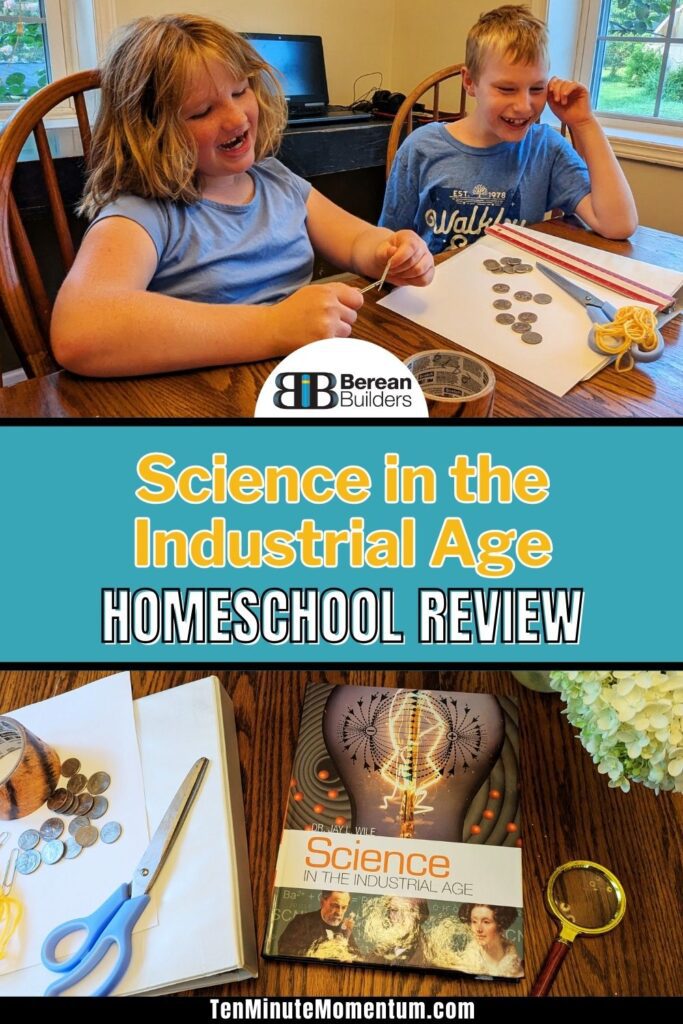
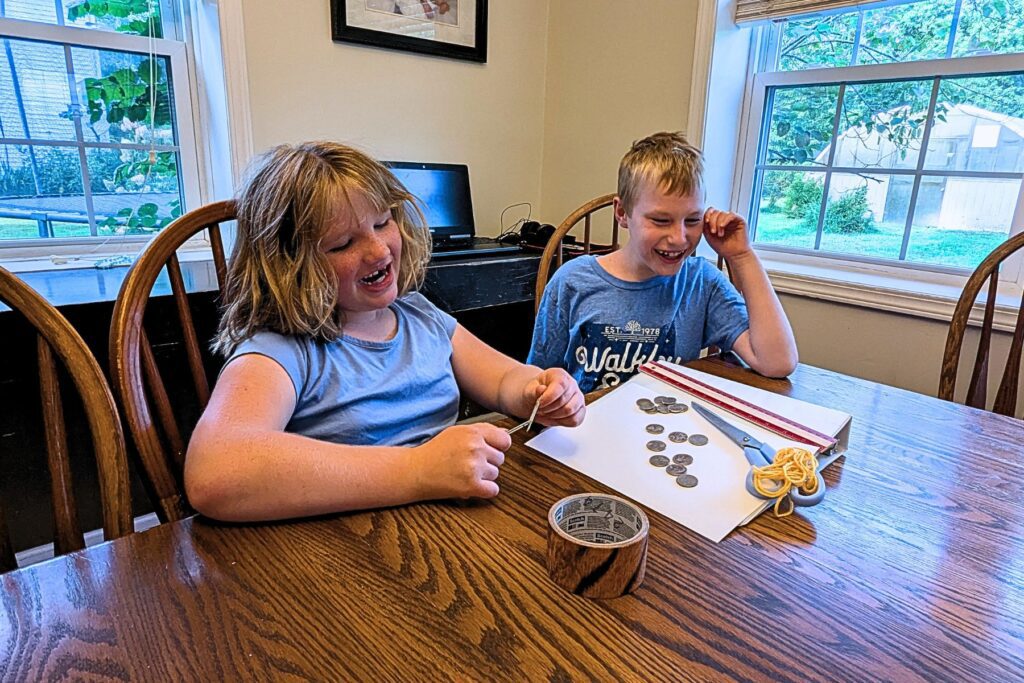
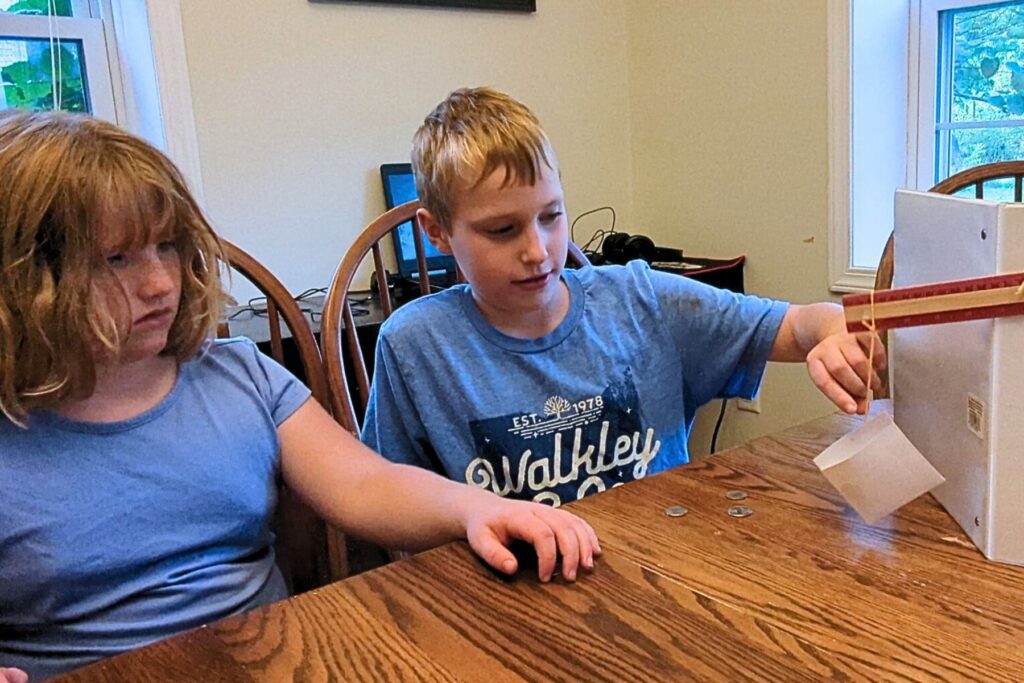
The experiments are simple but meaningful. You’re not going to need a full chemistry lab in your kitchen — most activities use materials you already have at home (vinegar, steel wool, ice, salt, etc.) — yet they illustrate big scientific principles in a way kids can actually grasp.
The lessons themselves are short and approachable. You can easily fit them into your day without it feeling like science has taken over your schedule, but they still pack in a lot of depth. Or, as our homeschool group used it, we did the experiments at co-op and learned the lesson at home.
One thing I appreciate is how accessible Science in the Industrial Age is for teaching multiple ages. Every lesson includes three levels of review questions — one for younger students, one for older, and one for the oldest — so you can teach all your kids together and adjust the expectations based on their age. This works great for families and in a homeschool co-op!
Why the Historical Approach Works

One of the unique strengths of Science in the Industrial Age — and all of Berean Builders’ elementary through middle school courses — is its historical approach to science. Instead of isolating topics into separate units, students learn science in the order it was discovered by the great scientists of history.
My kids and the kids in their co-op classes always enjoyed hearing stories about real people who made discoveries. Somehow focusing on these ordinary people made science seem so much more accessibly than a when it was all focused
This means they’re not just memorizing facts — they’re seeing how ideas developed over time, how mistakes led to breakthroughs, and how the Christian worldview shaped the growth of science. Dr. Jay Wile’s story-telling style keeps topics fresh by changing them frequently, so one week you might study electromagnetism and the next, cell structure.
This historical approach pairs beautifully with a more subject-based approach for middle and high school. In elementary, kids enjoy hearing all the stories and get a great overview of different science topics and then they can focus more on one science subject at a time in middle or high school.
Inside Science in the Industrial Ages– students learn about:
- Chemical formulas and compounds
- Earth’s magnetic field
- Dew, frost, and the dew point
- Electromagnetism
- The telegraph
- Cell structure and organelles
- Fermentation and vaccines
- Natural selection and adaptation
- The Periodic Table of the Elements
- Germ theory and DNA
- Light bulbs, X-rays, and radioactivity
Learn more about Berean Builders’ historical approach to science here.
Faith Integration & Worldview Notes
Berean Builders is written from a Christian homeschool science perspective, and Dr. Jay Wile doesn’t shy away from addressing big questions about creation, evolution, and the age of the earth. The text presents historical scientific theories (including evolutionary ideas) because they were important in the time period, but also provides young-earth creationist responses so parents can discuss the differences with their children.
This makes it a strong choice for Christian families who want to equip their kids to understand and evaluate different scientific viewpoints in light of Scripture.
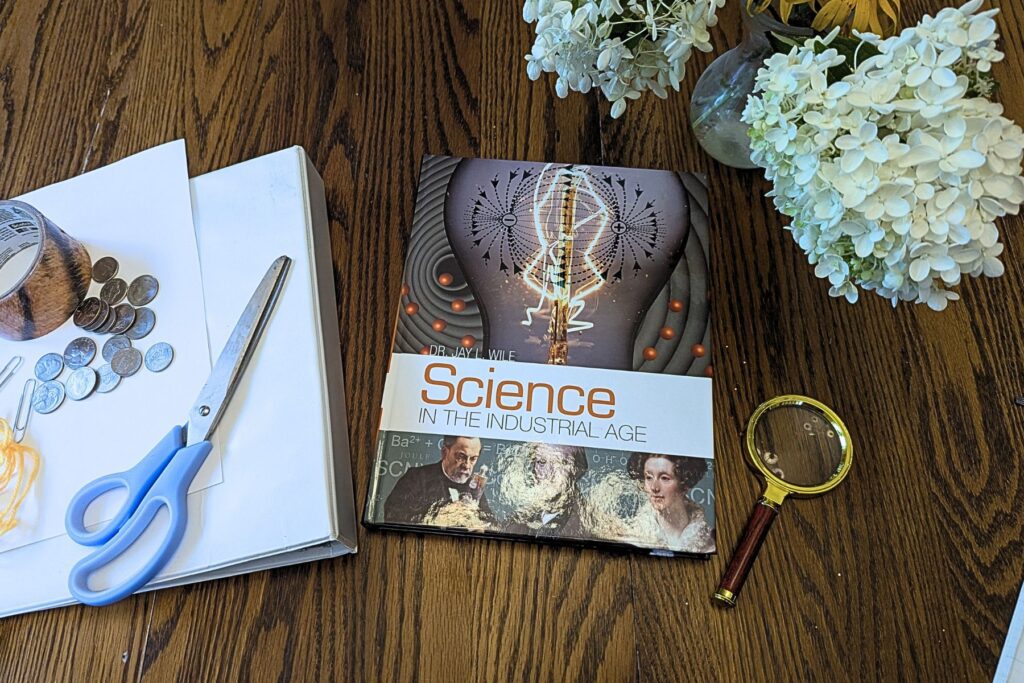
Simple Easy To Use Homeschool Science Curriculum (History Too!)
When I look at curriculum for elementary, I am always prioritizing how easy it is to use…for me and my kids. I also have in the back of my mind this filter of all the boxes I can check with one curriculum. And this science is unique with all the history it includes. In my opinion, if you have a year where you need to cover less, you could use this curriculum as your history spine as well…knocking out two birds with one stone!
Science in the Industrial Age includes:
- 90 lessons organized chronologically by scientist and discovery (this is roughly 2-3 lessons per week)
- Clear, engaging biographies that connect science to real people and events
- Step-by-step experiments for most lessons – these are very detailed and easy to follow
- Three levels of review questions for multi-age teaching – these can be used for narration, discussion or written answers.
- Coverage of a wide range of 19th-century science topics — chemistry, biology, physics, earth science, and more
- Historical context for scientific discoveries, including both old-earth concepts and evolutionary ideas with young-earth creationist responses provided
One of the things that I like the best about all of the Berean Builders elementary texts are the simple, short lesson structures.
Each lesson is built around one main scientist or concept and includes:
- A short, engaging reading (3–5 pages) that blends biography, history, and science.
- A hands-on activity or experiment to illustrate the concept.
- A short lesson review with separate question sets for youngest, older, and oldest students.
Truly, if you paired some notebooking pages and a timeline with this curriculum, you could easily use it for K-6 science and history. Isn’t that simple!
Can It Be Used in a Homeschool Co-op?
Science in the Industrial Age works beautifully in a co-op setting (as does all Berean Builder’s curriculum). And as I mentioned earlier, it pairs wonderfully with a 4-year history cycle. Our co-op used it for all 4 years and it was a great pairing.
Because the experiments use simple, inexpensive materials, it’s easy to prep for a group. The short readings can be done at home, and then the co-op class time can focus on the hands-on activities and discussion. The three-tiered review questions also make it easy to include a wide age range in the same class.
I love that near the front of the textbook is a comprehensive supply list for every 15 lesson or so. That means you can easily gather up all the supplies for a class only a few times a year. Or you can find a pre-prepared lab kit with all the supplies available through online retailers.
Tips for Co-op Use:
- Assign the reading at home and reserve class time for experiments.
- Use the oldest student questions for group discussion, then adapt for younger ages.
- Encourage students to keep a science notebook with experiment results and vocabulary.
- Plan ahead for any experiment materials — while most are household items, a few may need to be purchased.
Who This Curriculum Is Perfect For
I’m a huge fan of identifying who a curriculum is going to help the most. Science in the Industrial Age is an excellent fit for:
- Families homeschooling multiple children in grades K–6 who want to teach science together.
- Parents who want hands-on learning without excessive prep.
- Kids who are interested in both history and science.
- Families who enjoy covering a variety of science topics from across many disciplines in one course
- Christian families who want a Biblical worldview integrated into science lessons.
- Co-ops looking for a chronological, activity-rich science program.
This curriculum can also work well for middle school if a student isn’t quite ready for a rigorous science curriculum or if a parent is trying to keep a wide age-range of kids together!
Homeschool Science Curriculum Can Be a Great History Adventure Too!
Science in the Industrial Age is one of those rare homeschool science curriculum options that blends history, hands-on learning, and real scientific depth in a way that works for busy families. It’s flexible enough for a single student or a large co-op class, and it builds both knowledge and curiosity — the kind of science learning that sticks.
If you are in a season where you are trying to do it all with lots of kids or a busy schedule, Berean Builders elementary science is a great solution that is fun for kids AND easy for moms!

Sarah McCubbin and her husband and 9 kids live in Ohio. She loves talking about all kinds of education topics and is passionate about helping families find the best education options in each season! After being very socially awkward growing up, she now loves to help families teach life skills, social skills and leadership to their kids!
Connect With Sarah:
Schooling Year By Year Facebook Group
Facebook Page / Instagram @ten_minute_momentum
IndieEducationNetwork.com
More Reading: