
Growing up, I remember Martin Luther King Jr. Day always being acknowledged in school with different activities. We usually watched a short video clip of one of Dr. King’s speeches or talked about the events leading up to the Civil Rights Movement. We learned about segregation and how it created different rules for people based on the color of their skin.
We learned facts.
Information.
But as a kid, it wasn’t easy to translate how meaningful — or how important — those conversations would be later in life.
Frankly, my skin is white, and I grew up in a small farm town. The conversations about segregation, diversity, and racial inequality didn’t feel personal. They didn’t apply to anyone I knew directly. So while we learned information, it didn’t really stick.
Over time, that changed.
After 9/11, my brother — who has olive skin — was frequently profiled. I made close friends who shared how their experiences were different simply because of their skin color. And now, as we raise our adopted son, I find myself having conversations with him because of his brown skin that I never had to have with my other sons.
Those experiences reshaped how I understand these topics — and how important it is to help kids and teens move beyond memorizing facts to having meaningful conversations.
Martin Luther King Day offers a natural opportunity to pause, reflect, and learn alongside our kids. Depending on your children’s ages, the activities you choose may look different — but each one can open the door to deeper understanding.
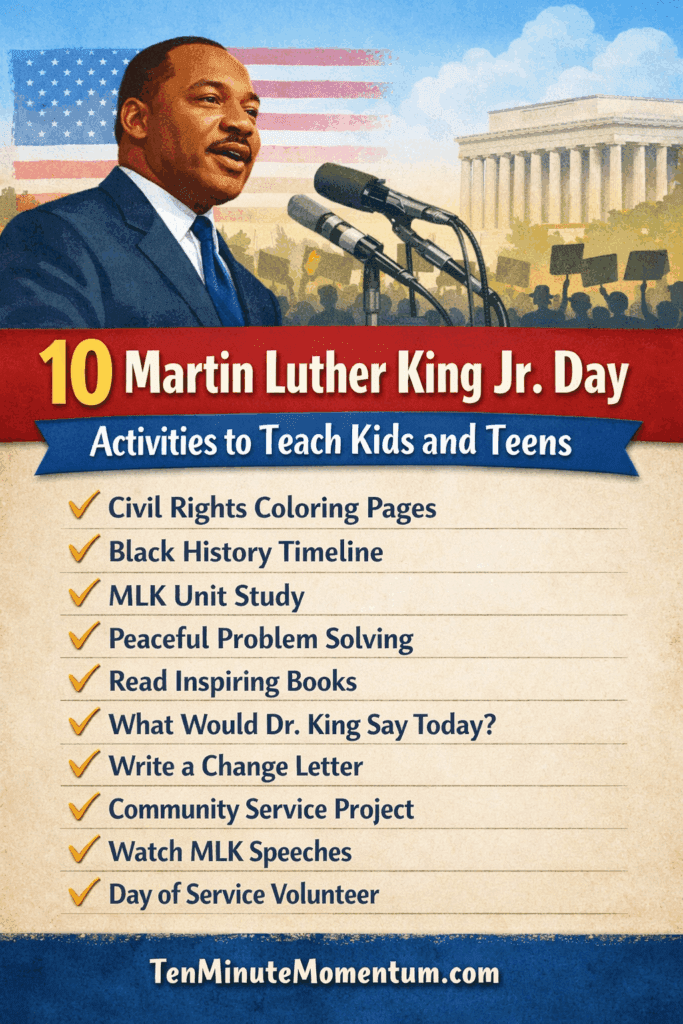
Here are 10 thoughtful Martin Luther King Day activities you can use with kids or teens to do just that.
Table of Contents
10 Martin Luther King Day Activities for Kids and Teens
Martin Luther King Day is more than a national holiday on the third Monday of January. It’s an opportunity to help young people understand American history, the civil rights movement, and how lessons from the past still shape the world today. These meaningful activities are designed to work for little children, older children, middle school, and even high school students.
1. Martin Luther King Jr. Coloring Pages (For Young Readers)
Coloring pages are one of the best ways to introduce Martin Luther King Day to young readers. As children color images connected to Dr. King’s life, talk about racial equality, the color of their skin, and why treating others fairly matters.
This simple activity is especially helpful for families with little children who are just beginning to learn about African Americans, racial discrimination, and human rights in age-appropriate ways.
2. Build a Modern Black History Timeline
Many kids learn about the civil rights movement but struggle to connect it to the world today. Creating a modern Black history timeline helps young minds see how Dr. King’s revolutionary spirit connects to events after his death and into Black History Month.
This activity works well for middle school and high school students and creates a fresh perspective on how social justice movements continue to shape American society.
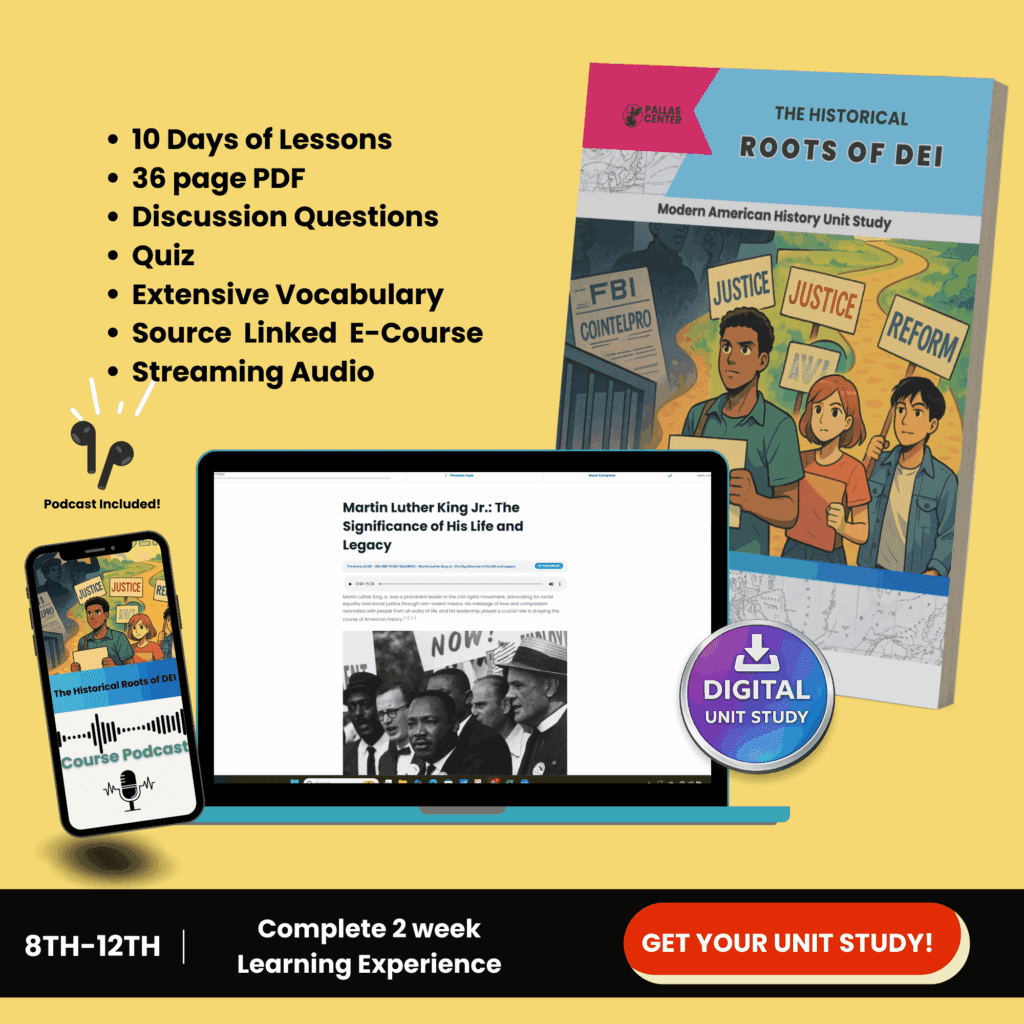
3. Complete a Martin Luther King or History of DEI Unit Study
A full unit study allows students to explore significant topics at a much deeper level. Younger students will benefit by learning about the life of Martin Luther King beyond a famous speech or a single lesson. Through reading, discussion, and lesson plans, kids learn about Dr. King as a civil rights leader, a Baptist minister, and a civil rights activist who challenged Jim Crow laws and racial segregation in the American South.
For older students, you have the option to take learning to a deeper level to learn about where diversity initiatives started, how it connects to Martin Luther King and how those initiatives were progressed and resisted by the U.S. government…all the way up until the present day! Older students can connect history as they see it touch current events.
This approach is ideal for homeschool families, public schools, and older children who are ready for deeper learning.

4. Practice Social Skills Through Peaceful Problem Solving
Dr. King believed deeply in peaceful protests and nonviolent marches. One meaningful activity is to help kids practice social skills by role-playing everyday conflicts and learning how to communicate calmly and respectfully.
This activity helps children apply lessons from King’s speeches to their own lives and understand how nonviolence can help create a better place in their homes, schools, and communities.
19 Ways for Kids & Teens to Make Friends Outside of School
5. Copywork Using King’s Speeches
Choose a short passage from one of King’s speeches — including lines inspired by the Dream Speech delivered near the Lincoln Memorial — and use it for copywork.
Copywork helps young people slow down and think deeply about Dr. King’s words while improving handwriting and comprehension. This works well for elementary students and can be adapted for older children with reflection questions.
6. Read Picture Books and Children’s Books About MLK
Reading picture books and children’s books with eye-catching illustrations is a powerful way to introduce Martin Luther King Day. Titles like Martin’s Big Words by Doreen Rappaport, illustrated by Brian Pinkney, help young readers understand the life of Martin Luther King in a relatable way.
You can also include books that mention figures like Rosa Parks, Mahalia Jackson, and Coretta Scott King to show that the civil rights movement involved many people working together.
7. Discuss “What Would Dr. King Say Today?”
For middle school and high school students, ask what Dr. King might say about issues in the world today. Topics could include racial equality, public places, different schools, or human rights.
This discussion-based activity encourages critical thinking and helps students see Dr. King not just as an American hero, but as a leader whose ideas still matter.
8. Write a “Change Letter”
Have kids write a letter about something they would like to see changed in their community or school. This could be related to fairness, kindness, or helping others.
9. Participate in a Day of Service
Martin Luther King Day is also recognized as a national day of service. Families can honor this by participating in community service projects such as food drives, neighborhood cleanups, or helping at local organizations.
Service helps kids understand that Dr. King’s vision was about action, not just words.
17 Ways: Find Local Volunteer Opportunities Near Me
10. Watch and Reflect on a Short Video Clip
Watch a short clip of one of Dr. King’s famous speeches or a documentary segment about the civil rights movement. Afterwards, discuss what students noticed about his leadership, courage, and message.
This activity works especially well for high school students and helps tie together themes of racial equality, social justice, and responsibility for future generations.
Why These Activities Matter
Whether you’re working with young readers, middle schoolers, or teens, the best way to honor Martin Luther King Day is through meaningful activities that help kids connect history to real life.
When children understand Dr. King’s life — including the challenges faced by Black people, African Americans, and others during the civil rights movement — they gain tools to build empathy, understanding, and hope for a better world.
Martin Luther King Day doesn’t need to be heavy or complicated to be meaningful.
Sometimes it’s as simple as coloring and talking.
Sometimes it’s reading, asking questions, or practicing empathy in everyday situations.
And sometimes it’s realizing — as adults — that these conversations matter more than we once understood.
When we help kids and teens connect history to real life, we give them more than information. We give them language, perspective, and the ability to relate to people whose experiences are different from their own.
Whether you choose one activity or several, the goal isn’t perfection — it’s presence. Learning together. Talking honestly. And allowing history to shape how we show up in the world today.
And that, in many ways, honors Dr. King’s legacy far more than a day off ever could.

Sarah McCubbin and her husband and 9 kids live in Ohio. She loves talking about all kinds of education topics and is passionate about helping families find the best education options in each season! After being very socially awkward growing up, she now loves to help families teach life skills, social skills and leadership to their kids!
Connect With Sarah:
Schooling Year By Year Facebook Group
Facebook Page / Instagram @ten_minute_momentum
IndieEducationNetwork.com
More Reading: